

AC leak detection matters most in Cumming the moment warm air starts pushing through the vents on a GA-400 commute. Georgia summers run hot and humid for months at a time, and any small gap in a hose or seal shows up fast under that kind of strain.
This guide walks through why the leak happens, how a proper diagnosis finds it, and what driving feels like once it's resolved.
Which Cumming Driver Are You?
You might be someone who spends forty-five minutes a day merging onto GA-400 toward Alpharetta, watching the temperature gauge climb right along with the traffic. Or you're the parent doing the school run near Cumming City Center, trying to keep a car full of kids comfortable in July.
Some drivers only notice the problem on weekend trips out toward Lake Lanier or Buford Dam Road, when the AC has to work its hardest for the longest stretch. Others catch it running errands around Suwanee or Sugar Hill, where stop-and-go traffic gives a slow leak plenty of time to show itself.
Each of these driving patterns puts different stress on a slow leak, but the underlying issue tends to be the same. The fix usually starts the same way too, a proper diagnostic visit through our services team, rather than guessing at the cause from the driver's seat.
Matching Your Symptoms to the Right Fix
Not every warm-air complaint means the same thing under the hood. A leak near a hose fitting behaves differently than one closer to the evaporator core, and the timeline for each looks different too.
Before jumping to a recharge, it helps to know what your specific symptoms are pointing to, especially heading into a Georgia summer, when a small leak has months to turn into a bigger one.
| If You're Noticing This | Likely Cause | Why It Matters |
|---|---|---|
| Warm air after 10 to 15 minutes of driving | A slow leak at a hose fitting or seal | Confirms a leak instead of a failing compressor |
| A sweet smell or foggy windshield | A leak near the evaporator core | Points to a repair before it affects visibility |
| AC that worked after a recharge, then stopped again | The leak was never located, only masked | Shows why finding the source matters more than a temporary refill |
Matching the symptom to the cause is what separates a lasting fix from a repeat visit. A recharge might buy a few weeks of cold air, but it doesn't address why the refrigerant disappeared in the first place.
Drivers who've been through a few recharges already know the pattern: cold air for a while, then warm air again right when the heat is worst. Our team walks through this with every Cumming driver before recommending next steps, which you can review on our offers page.
What This Looks Like on Your Commute
Georgia heat doesn't ease up for months, and a car sitting in GA-400 traffic near Cumming City Center puts real strain on an AC system with even a small leak. A leak that seems minor in spring often becomes obvious by the first heat wave, when the system simply can't keep up anymore.
Parking downtown or making the drive out toward Buford Dam Road on a Saturday shouldn't mean choosing between comfort and getting where you're going. It's not the most exciting repair on a car, but it's one of the most noticeable once it's fixed.
Cold air on demand, even after forty minutes in traffic, is the real marker that the leak was found and sealed correctly. That kind of consistency matters just as much on a short errand around Sugar Hill as it does on a longer haul toward Suwanee.
After the Leak Is Found
Once the leak location is confirmed, the timeline is usually straightforward. Week one typically means the repair itself, replacing the specific seal, hose, or fitting that failed rather than the whole system.
A few weeks later, the difference shows up in ordinary moments, no more mentally bracing for warm air after a stoplight. From there, reliability comes down to normal maintenance, the same way it would for any other part of the car.
Drivers who take this route tend to stop thinking about their AC at all, which is really the goal. For questions about what a visit involves, our about us page outlines how our team approaches diagnostics, and what to expect from the first conversation.
Common Questions About AC Leak Detection in Cumming
These are the questions Cumming drivers ask most often before scheduling an AC leak detection visit.
What causes an AC leak in a Cumming summer?
Most AC leaks come from a worn hose, a failing seal, or a small crack at a fitting, and Georgia's heat and humidity make any weak point show up faster than it would in a milder climate. Constant use on hot commutes accelerates wear that might otherwise take years to become noticeable.
How long does AC leak detection take?
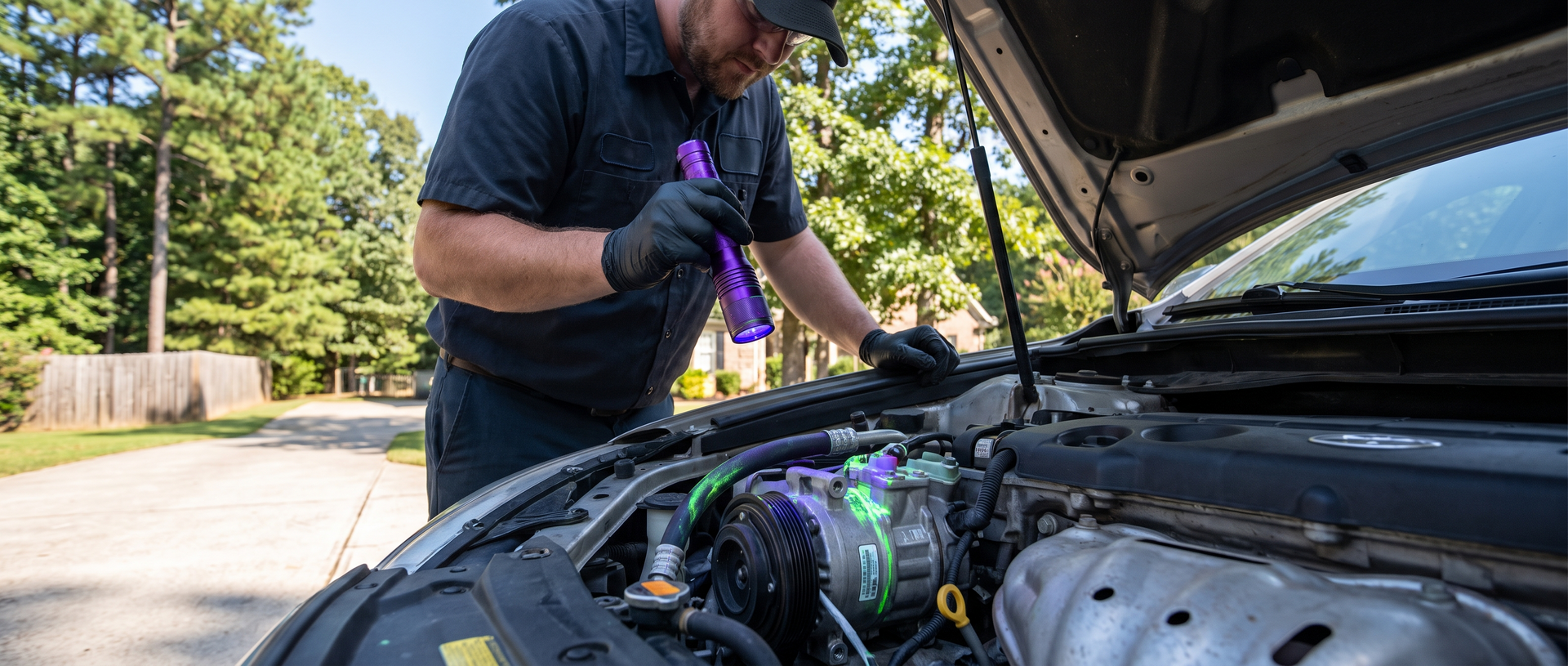
A proper leak detection visit typically takes less than an hour, using dye or electronic sensors to pinpoint the exact source rather than guessing. That's usually faster than the guesswork involved in repeated recharges that never solve the underlying problem in the first place.
Can I just recharge the AC instead of finding the leak?
A recharge cools the car temporarily but doesn't stop refrigerant from leaking back out through whatever gap caused the problem originally. Most Cumming drivers who skip leak detection end up recharging again within a few months, which costs more time in the long run.
Does Georgia heat make an AC leak worse?
Yes, higher temperatures increase pressure inside the AC system, which can widen an existing leak point that was barely noticeable before. A leak that's easy to miss in cooler months often becomes obvious during peak Cumming summer heat, right when it matters most.
Cold Air, Every Cumming Summer
A car that blows warm air on the GA-400 commute usually isn't a mystery, it's a leak waiting to be found. If the goal is consistent cold air through every Cumming summer, proper leak detection gets there faster than repeated recharges ever will.
Once the source is identified and repaired, the daily drive becomes one less thing to think about, whether that's the school run, the office commute, or a weekend out toward Lake Lanier. Contact us to talk through what you're noticing, or head to our schedule service page to find a time that works.